Music Player
A full music player built into the firmware: your own music with playlists, internet radio, podcasts, synced lyrics and audiophile-grade output. Open it from Tools → Music Player.
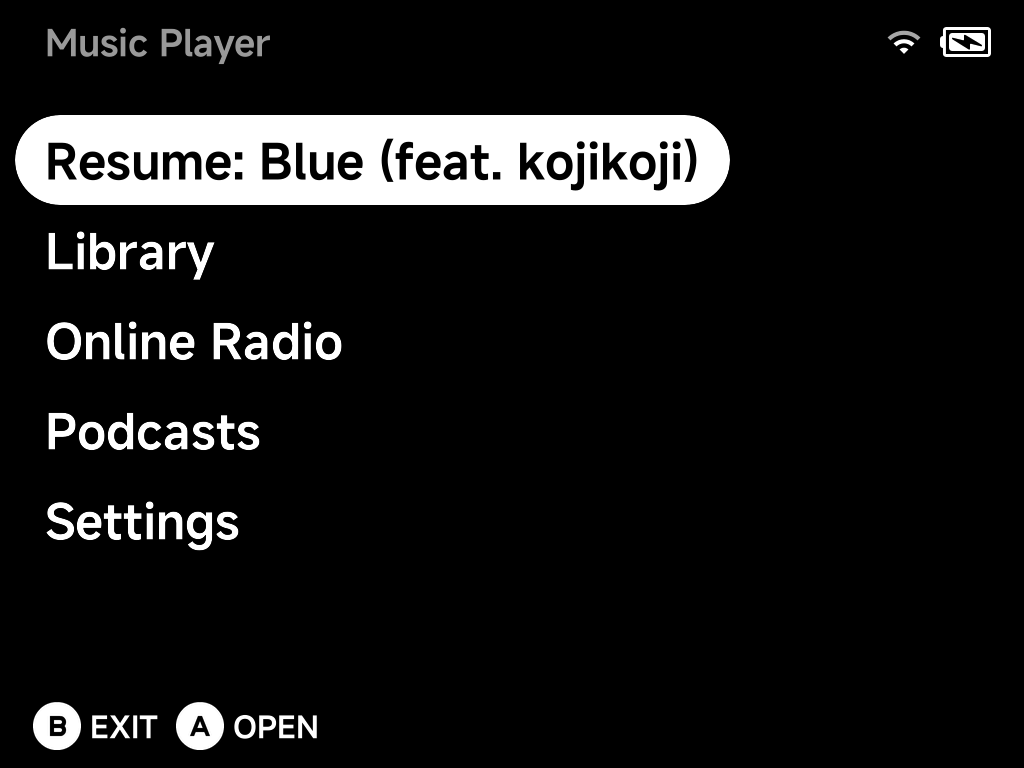
The home screen offers:
- Resume: pick up the last track where you left off.
- Library
- Online Radio
- Podcasts
- Settings
Library
Put your music in the Music folder on the SD card. The Library has two
views: Files (browse your folders directly) and Playlists.
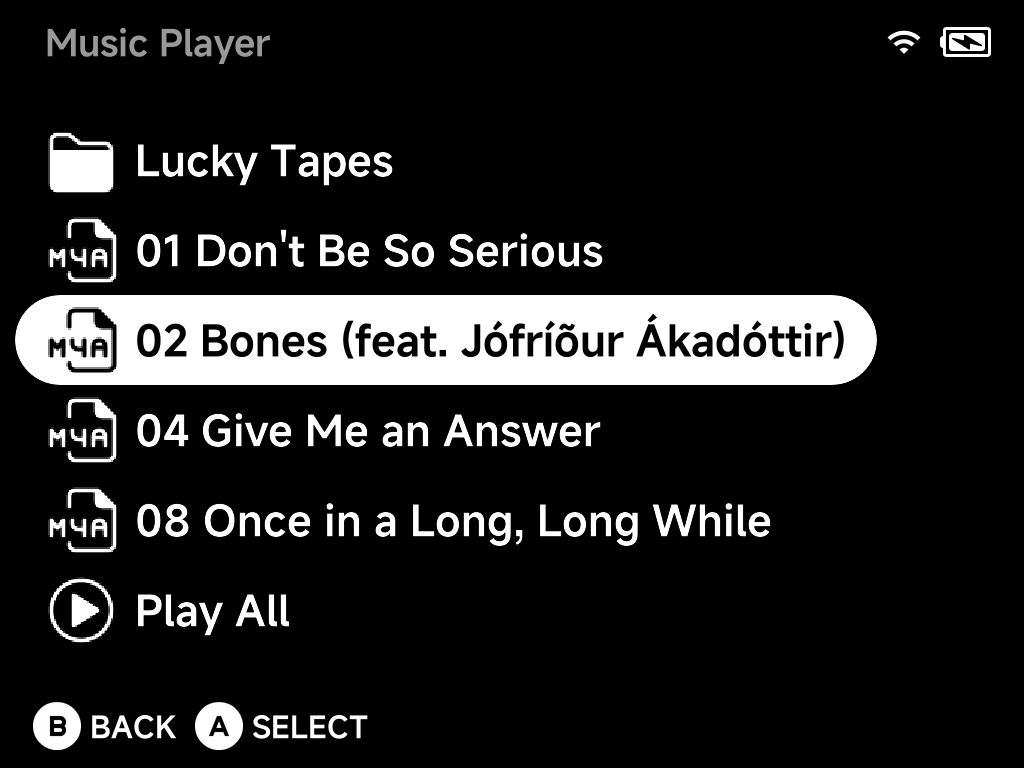
The Files view mirrors your folder structure, so organizing with folders
works naturally. Drop loose tracks straight into Music, or group songs in
folders. In the screenshot above, a Lucky Tapes folder collects that
artist's songs while the other tracks sit at the top level.
- Each file shows its format icon.
- Every folder gets a Play All entry that plays its contents in one go.
- For hand-picked track sequences across folders, use Playlists. Folders and playlists work side by side.
Supported formats: mp3, flac, wav, ogg, opus, m4a, aac and
mod tracker modules.
Titles, artists, albums and cover art come from the tags inside your files (MP3, M4A, FLAC, Ogg and Opus), so tagged music shows its real names and album art without being online. Untagged files show their file name.
Managing files
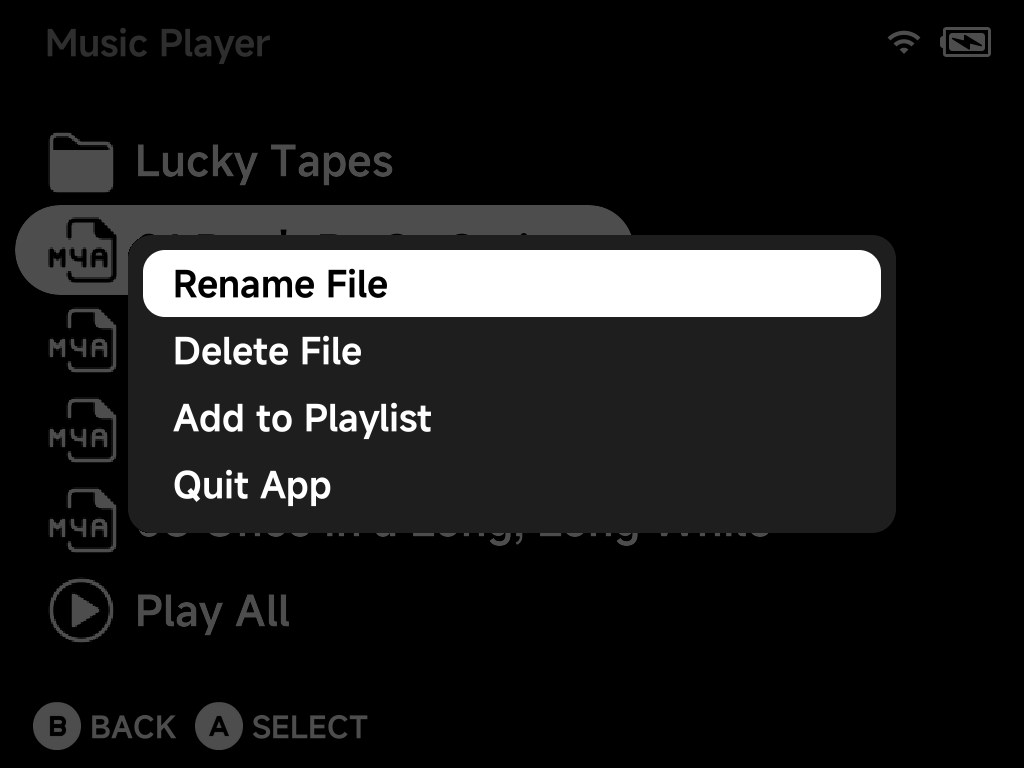
Press MENU on any track or folder in the Files view for its context menu:
| On a track | On a folder | What it does |
|---|---|---|
| Rename File | Rename Folder | Rename with the on-screen keyboard |
| Delete File | Delete Folder | Delete, after a confirmation |
| Add to Playlist | Add Folder to Playlist | Add the track (or all of the folder's tracks in one go) to an existing playlist, or create a new one on the spot |
Playlists
The Playlists view lists your playlists with their track counts:
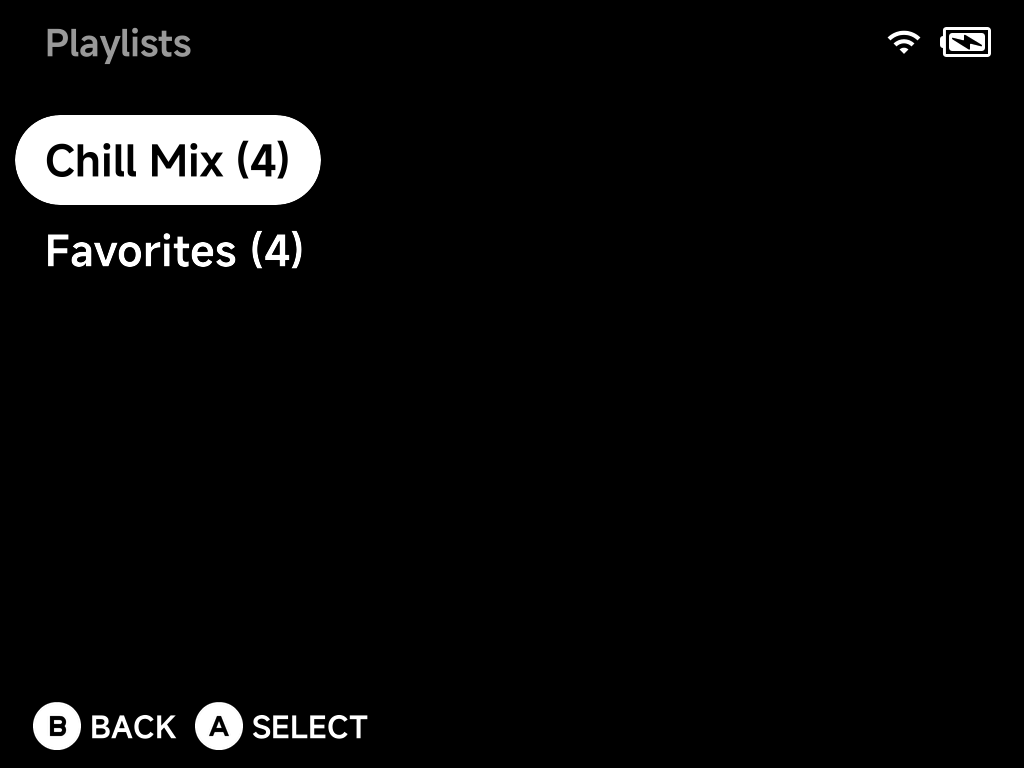
Aopens a playlist. From inside, pick a track to start playing.Ycreates a new playlist, named with the on-screen keyboard. With no playlists yet,Aon the empty page does the same.- To add tracks, use the Files view's context menu: Add to Playlist for a single track, Add Folder to Playlist for a whole folder.
Press MENU on a playlist to manage it:
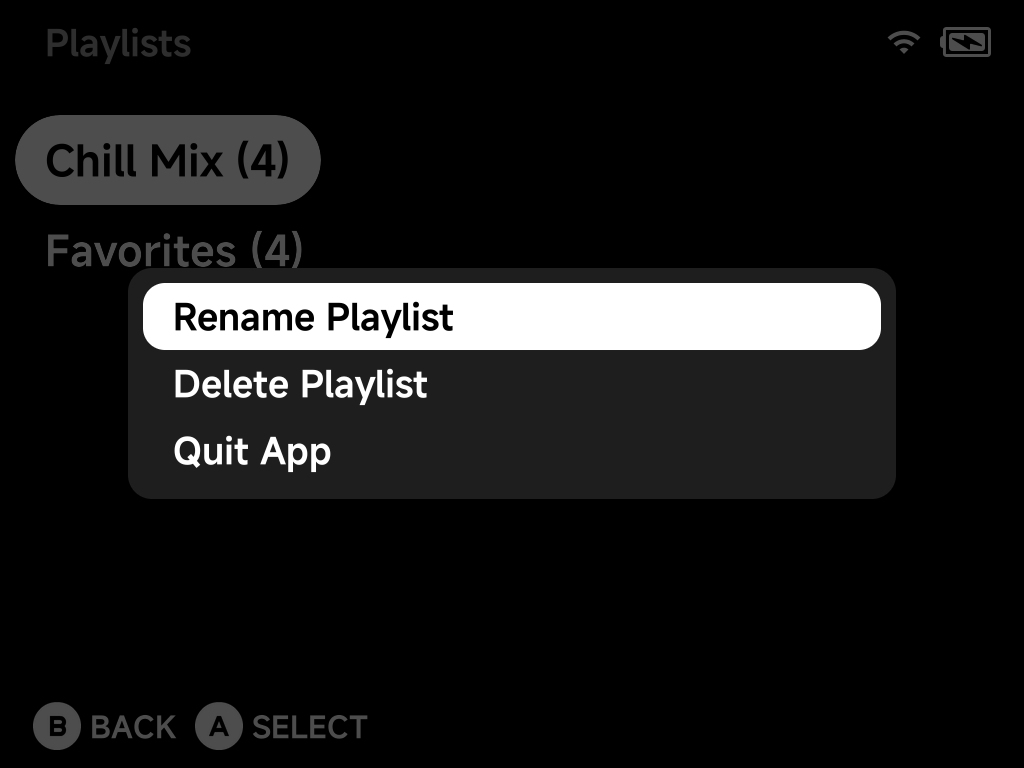
- Rename Playlist: via the on-screen keyboard.
- Delete Playlist: with a confirmation dialog.
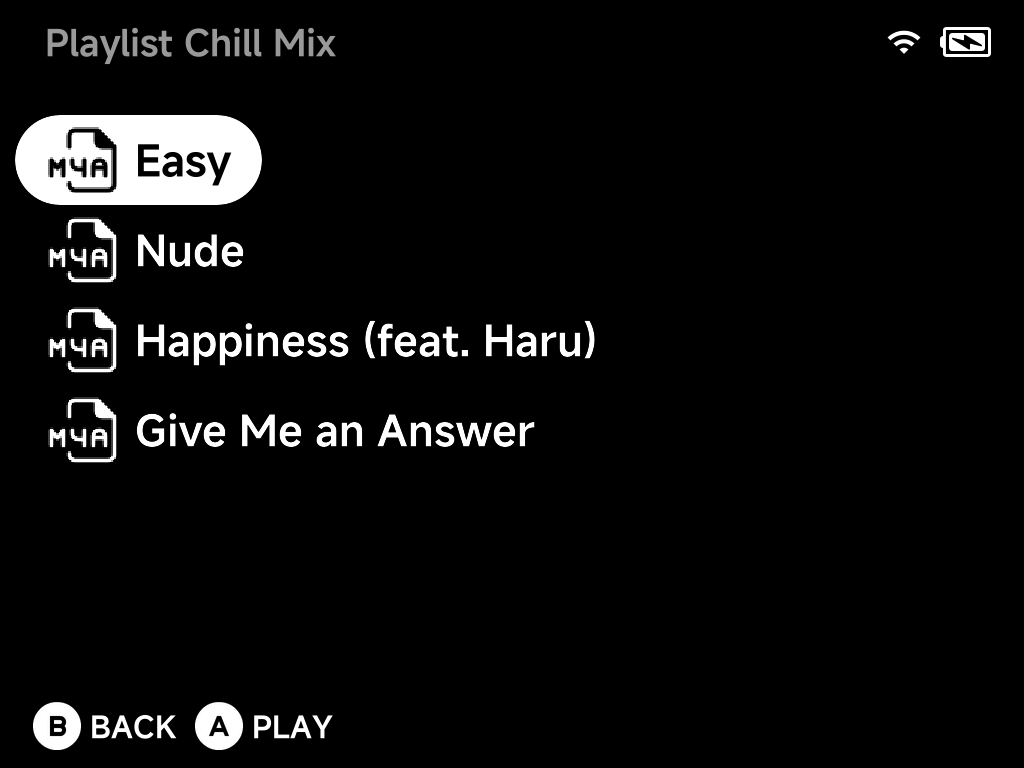
Open a playlist to see its tracks. A starts playing from the selected
track:
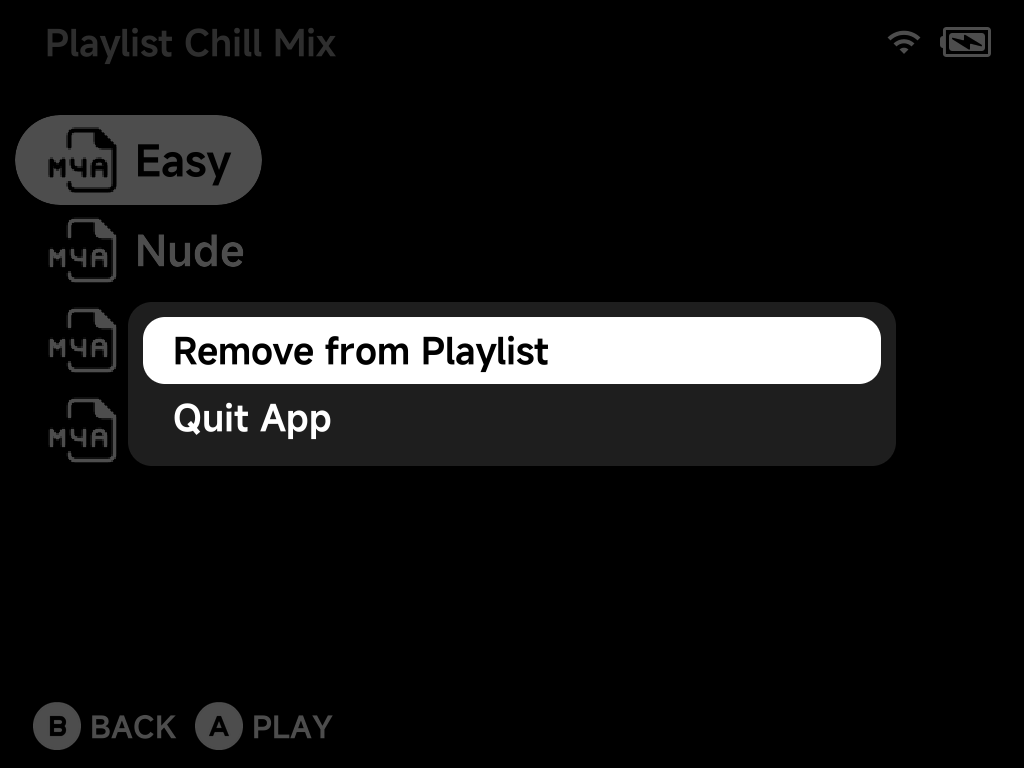
Inside, MENU on a track offers Remove from Playlist (also confirmed
before removing):
More detail
Playlists are standard .m3u files stored in
.userdata/shared/music-player/playlists, so you can also create or edit
them from a computer.
Now playing
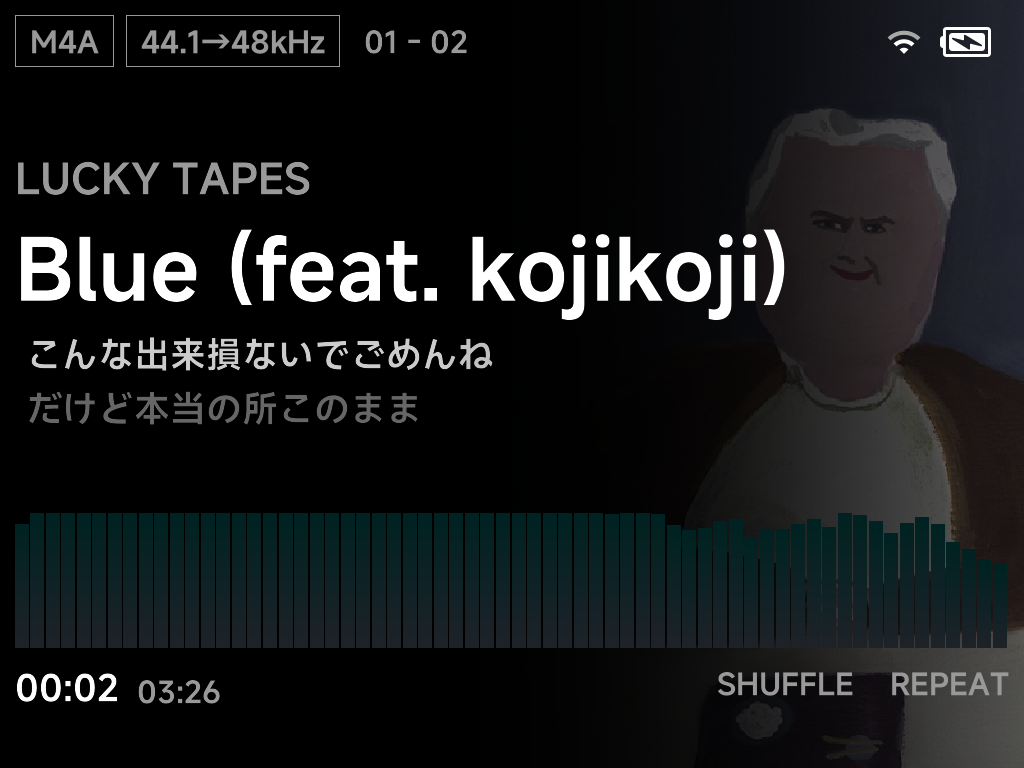
The now-playing screen shows cover art, a spectrum visualizer, shuffle and
repeat state, the format badge (M4A, FLAC…) and the live sample-rate
badge.
Synced lyrics scroll in time with the song. Lyrics embedded in the file are used first; otherwise they are fetched automatically when online.
More detail
- The sample-rate badge reads, for example,
96kHzwhen playing natively on a capable output, or44.1→48kHzwhen resampling. - Lyrics are looked up in this order: timed lyrics embedded in the file, the on-SD cache, LRCLIB (cached on the SD card once fetched), then plain embedded lyrics, which scroll evenly over the song.
Controls
| Button | Action |
|---|---|
A |
Pause / resume |
B |
Back to the browser — music keeps playing while you browse |
Left / Right |
Seek −/+ 5 s (hold to keep seeking) |
Up / R1 |
Next track |
Down / L1 |
Previous track |
X |
Toggle shuffle |
Y |
Toggle repeat |
F1 / L2 |
Cycle the visualizer style |
F2 / R2 |
Toggle lyrics on or off |
MENU |
Show this controls list on screen (any button closes it) |
SELECT |
Turn the screen off now (see below) |
SELECT + A |
Wake the screen when it is off |
With shuffle on, previous retraces the tracks that actually played, in order.
Auto screen off
While music plays, the screen switches itself off after an idle time you can set (default 60 s). This saves battery and prevents accidental button presses.
- While the screen is off, ordinary buttons are ignored.
- Tap
SELECTto turn the screen off right away instead of waiting. - Press
SELECT+Ato wake it. - Media buttons on a USB or Bluetooth headset keep working even with the screen off.
Background playback
Music, radio and podcasts keep playing when you leave the Music Player, both in the menus and inside games.
Control it from the OSD
The OSD's Music widget shows the current track or station with play/pause, previous and next, from anywhere.
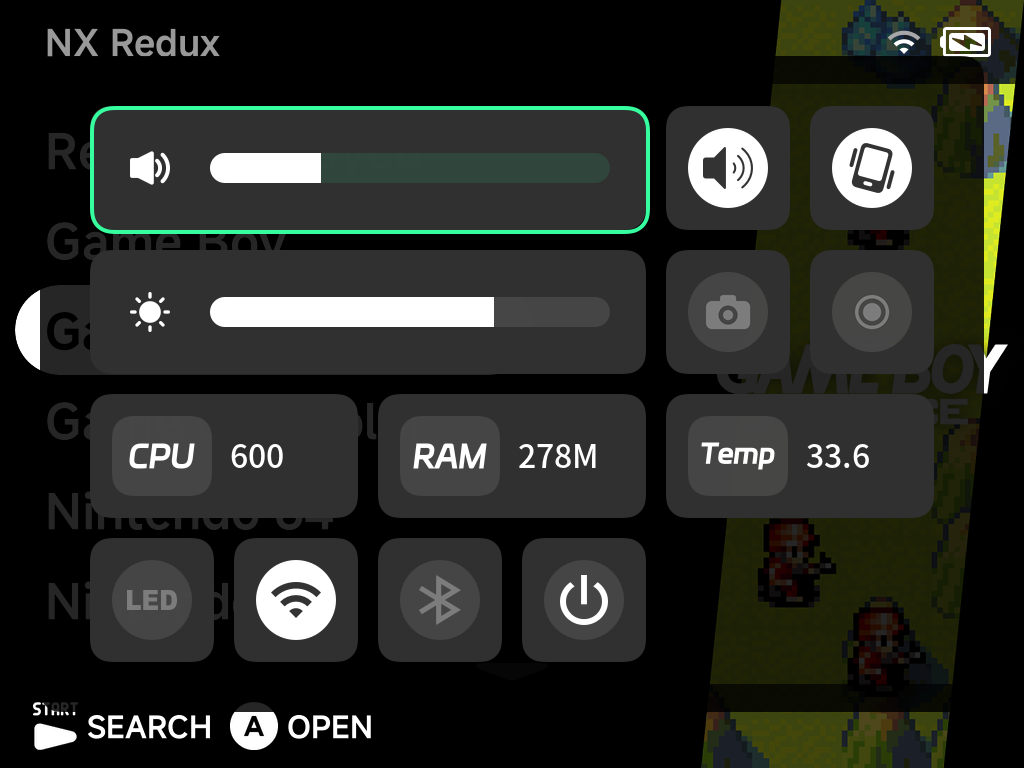
Below it sits the Game / Music balance slider (press Down to reach it). It
sets how loud games are relative to the music, from 50/50 through
Music +5, on top of the normal volume keys. The same setting is Balance
in the Music Player's Settings, so you can still reach it with nothing
playing.
What happens when the device sleeps or restarts
| Situation | What happens |
|---|---|
| Sleep | Outside the app, background music follows the device's normal sleep timers. When the screen times out the music stops and the device goes to sleep. Waking it picks the track up where it stopped |
| Power-off or restart | Playback never starts by itself. The last track, station or episode is restored paused at the position you were at, so the first sound the device makes is one you asked for. Press play in the widget or in the app to continue |
| Nothing playing for a few minutes | Playback gets out of the way to save battery, keeping its resume point. Opening the Music Player brings it straight back |
Tip
To keep listening with the screen dark, stay in the Music Player and let its own auto screen off handle the display.
More detail
Playback is owned by a small background service, so the app is just a remote control for it. It is this service that shuts itself down when nothing has been playing for a few minutes.
Online Radio
Online Radio streams internet stations, with cover art fetched for the currently playing song.
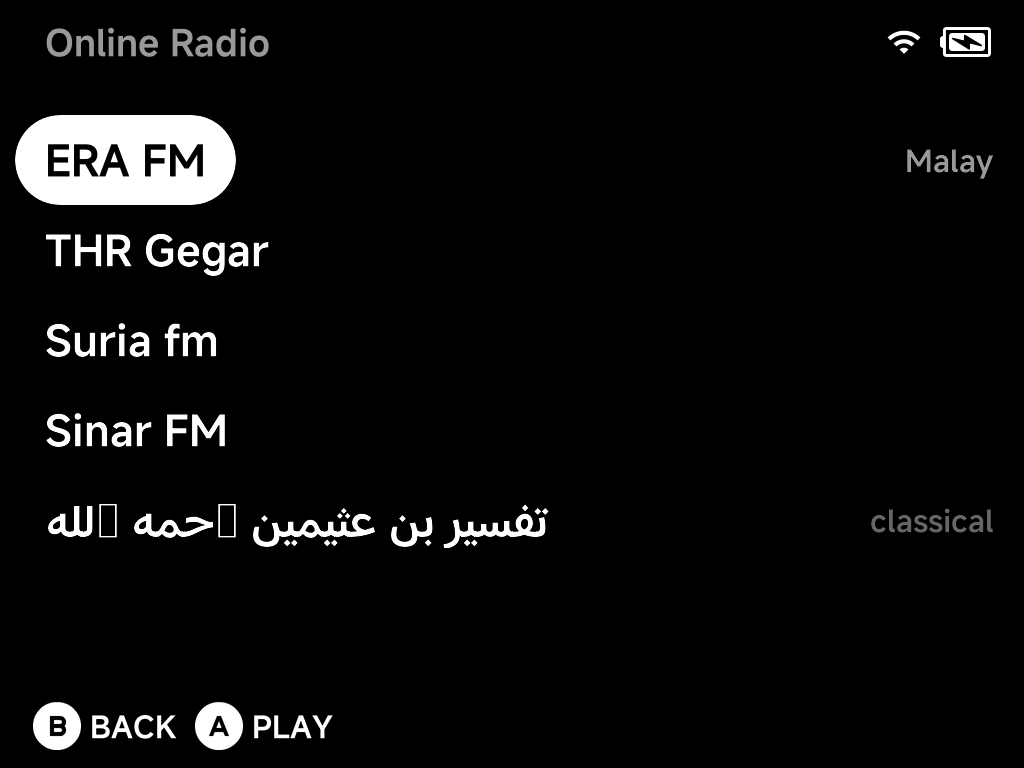
The page lists your stations. A plays one. Press MENU for the context
menu: Manage Stations (browse the online catalog), Delete Station, and
Playback Controls.
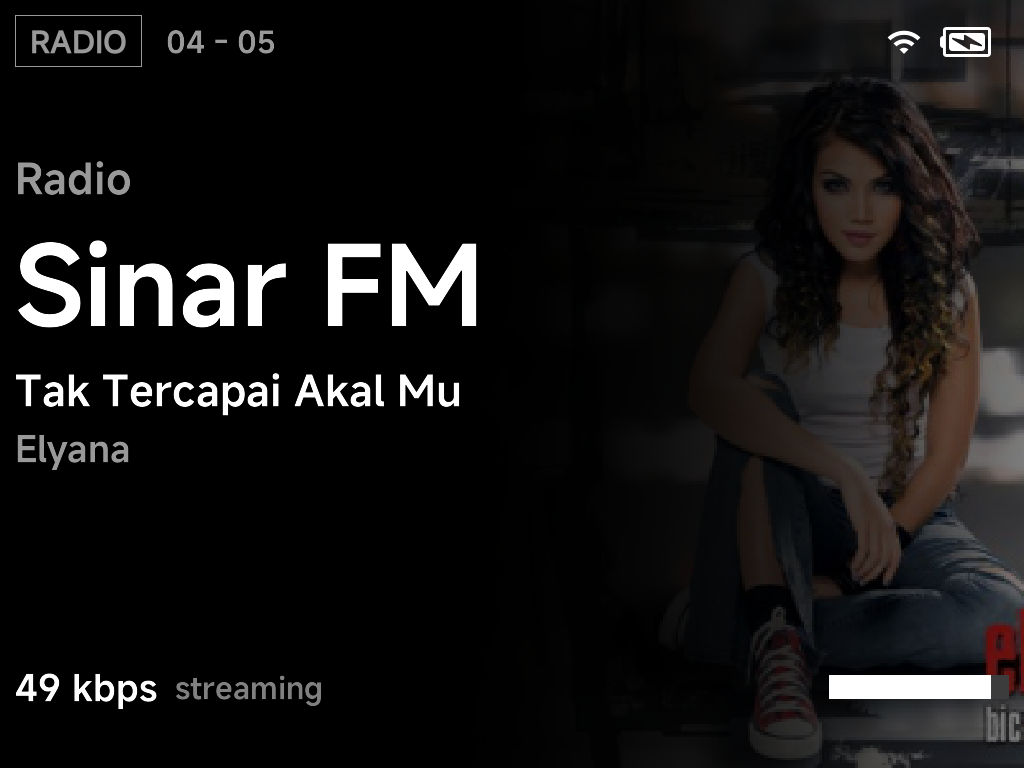
While a station plays, the screen shows:
- the station name
- the current song from the stream's metadata, with cover art fetched automatically for the playing song
- the live stream bitrate
More detail
Radio goes through the same high-quality resampler as local playback.
Radio controls
| Button | Action |
|---|---|
A |
Stop / resume the stream |
B |
Back to the station list — the radio keeps playing |
Up / R1 |
Next station |
Down / L1 |
Previous station |
MENU |
Context menu (including Playback Controls, this list on screen) |
SELECT |
Turn the screen off now |
SELECT + A |
Wake the screen when it is off |
Auto screen off works here exactly like local playback, including the idle timeout and headset media buttons staying live while the screen is dark.
Adding stations
Choose Manage Stations to browse the station catalog by country, and add
what you like. Availability varies, as the one-time notice says. Inside the
catalog, MENU offers Refresh List and Manual Setup Help.
You can also add stations by hand, as the built-in help describes. Edit this file:
.userdata/shared/music-player/radio/stations.txt
MP3, AAC and M3U8 streams are supported, up to 32 stations.
More detail
- The catalog comes from the community-run radio-browser.info index.
-
In
stations.txt, put one station per line:Name|URL|Genre|SloganThe slogan is optional (shown when the stream carries no song info).
-
A good directory for stream URLs is fmstream.org.
Podcasts
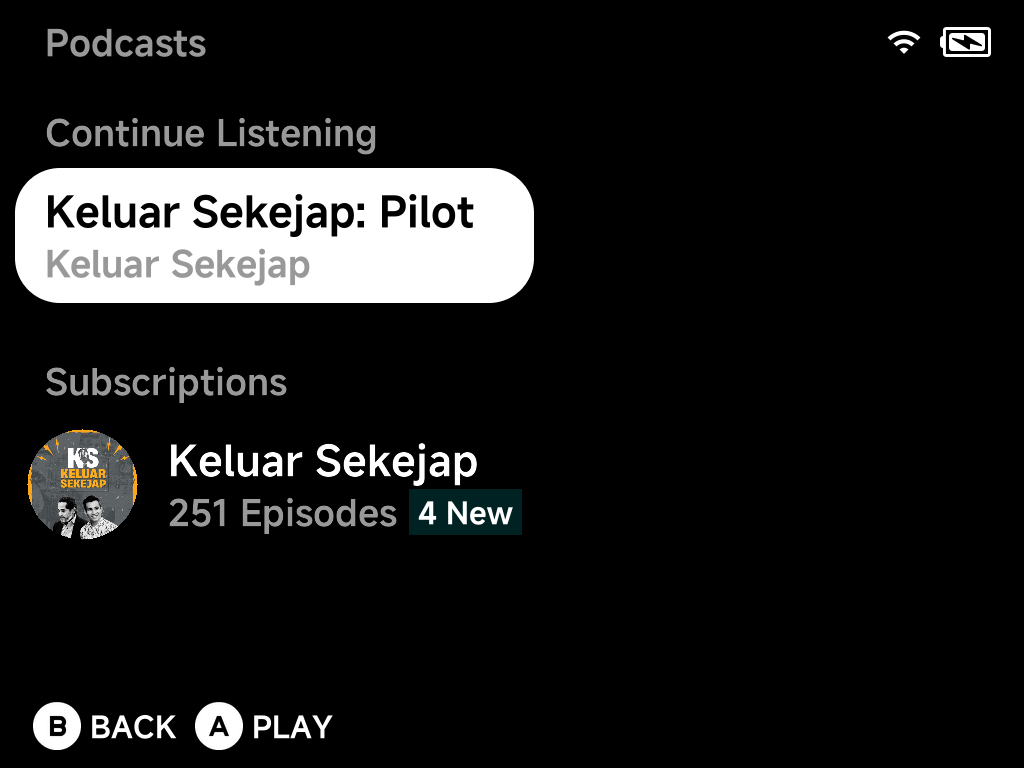
The Podcasts page shows:
- Continue Listening: episodes you're partway through. Playback position is remembered per episode.
- your Subscriptions, each with its episode count and a New badge.
Press MENU on a subscription for its context menu:
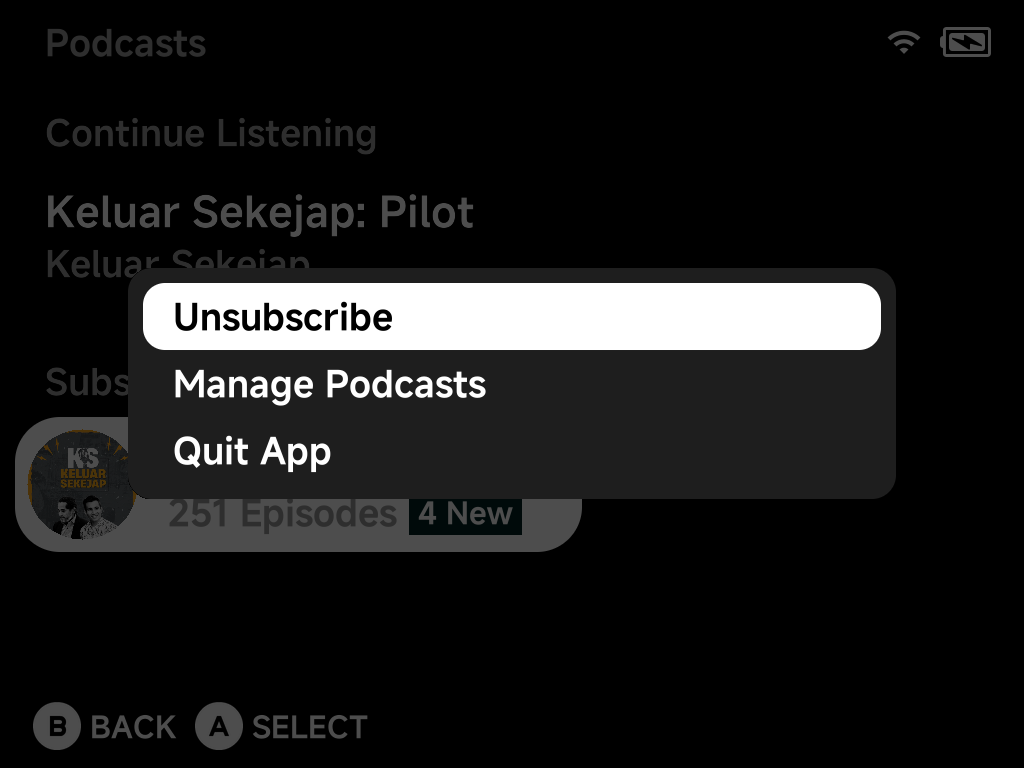
- Unsubscribe: remove the podcast, with a confirmation.
- Manage Podcasts: subscribe to new shows (below).
- Refresh List appears when you need to re-fetch feeds.
Subscribing
Manage Podcasts offers two ways in, both backed by the Apple Podcasts directory:
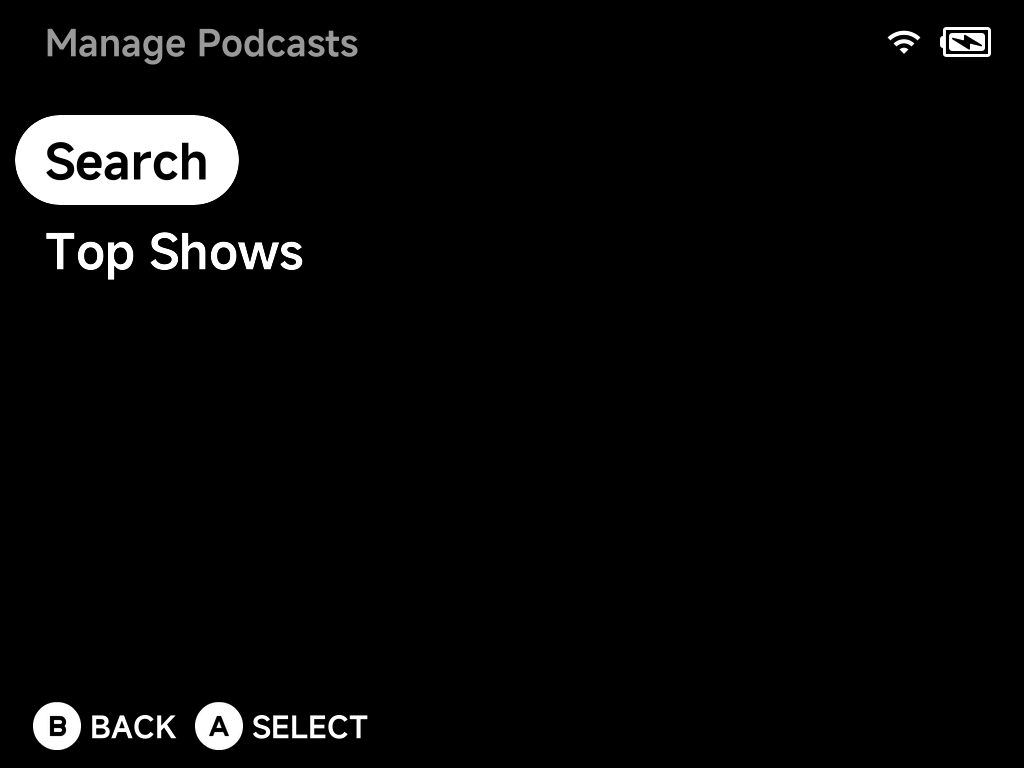
- Search: find a show by name with the on-screen keyboard.
- Top Shows: browse the podcast charts for your country.
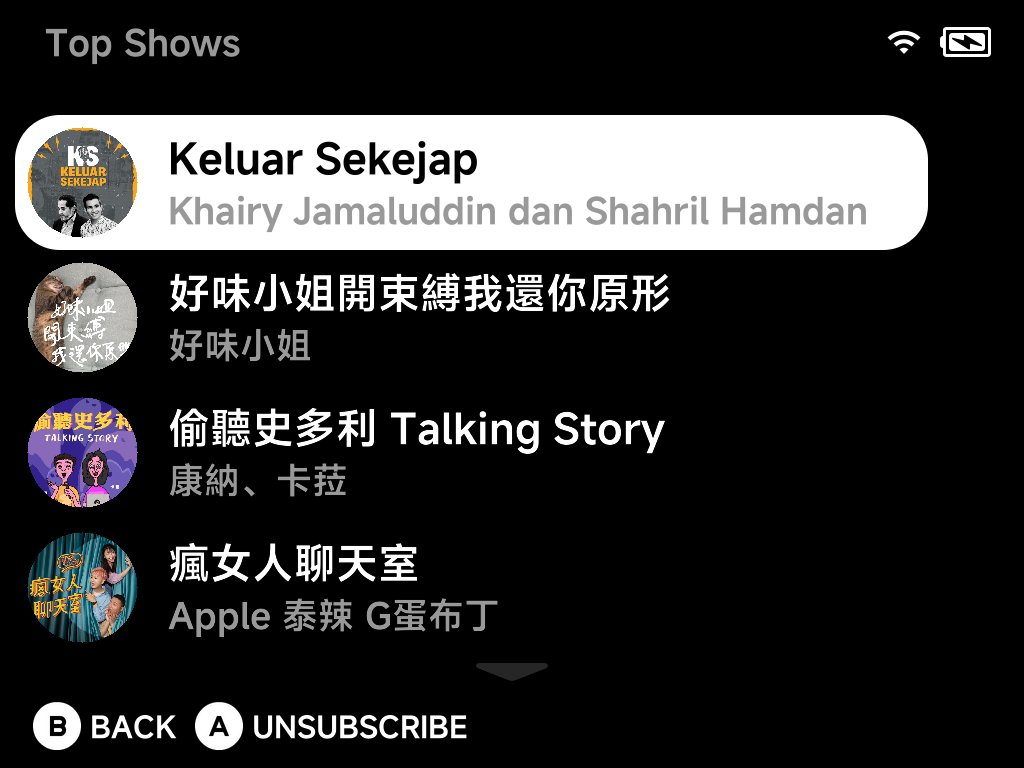
A subscribes to the selected show, or unsubscribes if you already follow it.
The hint bar tells you which.
Episodes
Opening a show lists its episodes under the show's artwork and description. Each shows its duration, age, a New badge for fresh episodes, and a download indicator:
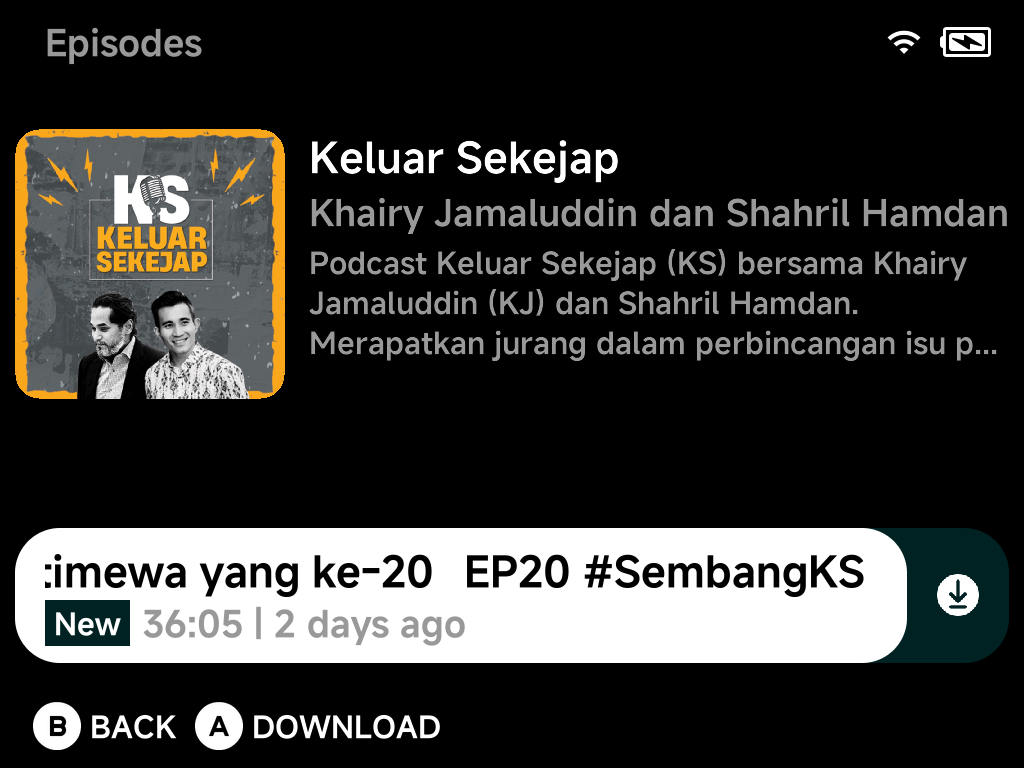
Episodes are downloaded to the SD card for offline listening:
- On a new episode, press
Ato start the download (the hint bar shows it). - Once downloaded, press
Ato play.
Press MENU on an episode for its context menu:
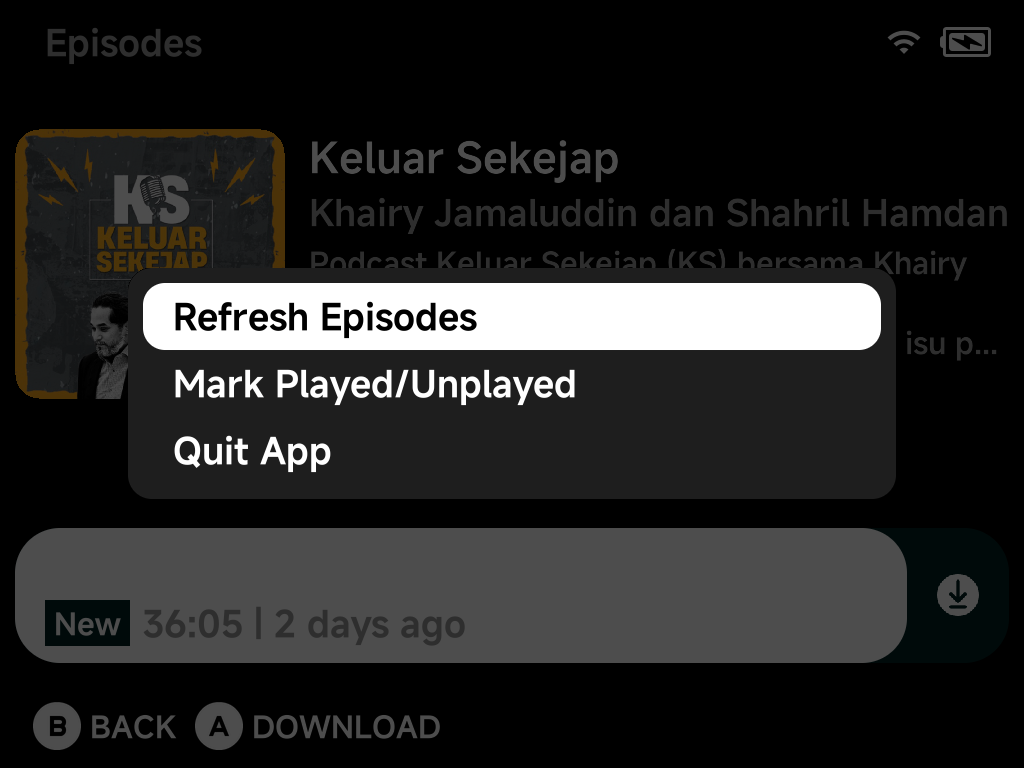
- Refresh Episodes: re-fetch the show's feed.
- Mark Played/Unplayed: toggle the episode's played state.
- Remove Download: added for a downloaded episode.
- An episode mid-download offers cancelling it.
Podcast player
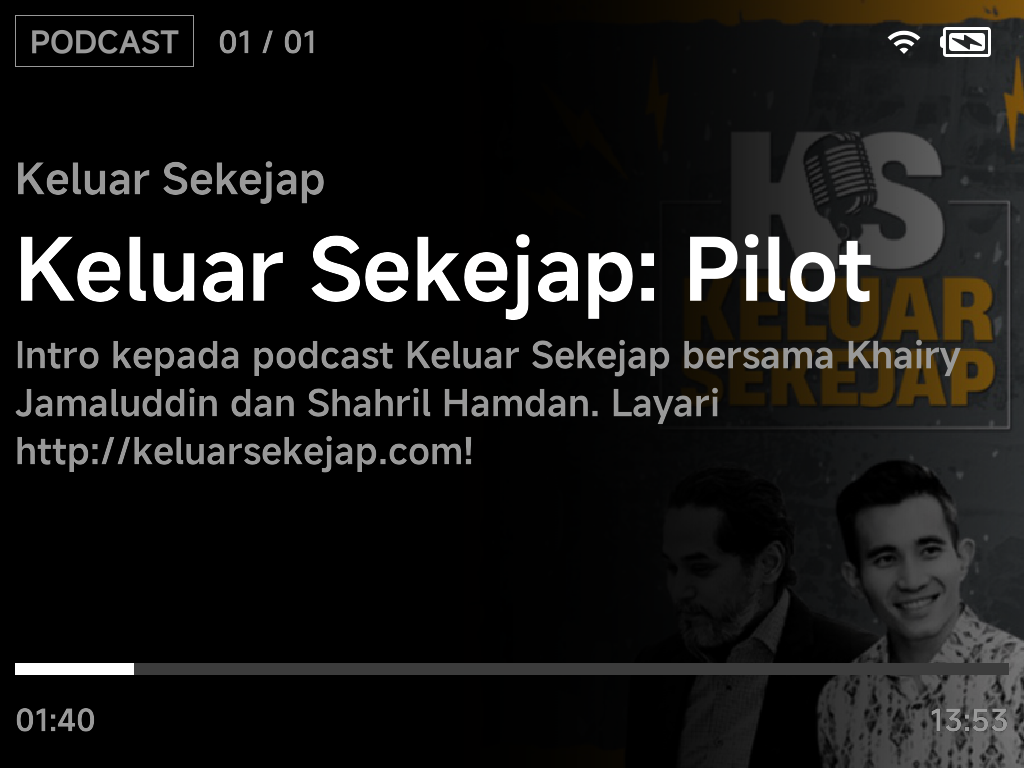
The player shows the episode description over the show's artwork, with a progress bar and position. Playback position is saved as you listen, so Continue Listening can pick the episode back up later.
| Button | Action |
|---|---|
A |
Pause / resume |
B |
Back to the episode list — audio keeps playing (if paused, stops) |
Left |
Skip back 10 s (hold to keep skipping) |
Right |
Skip forward 30 s (hold to keep skipping) |
Up / Down |
Playback speed up / down (0.5× – 2×, in 0.25 steps) |
SELECT |
Turn the screen off now |
SELECT + A |
Wake the screen when it is off |
Auto screen off applies here too: idle timeout, and headset media buttons keep working while the screen is dark.
Settings
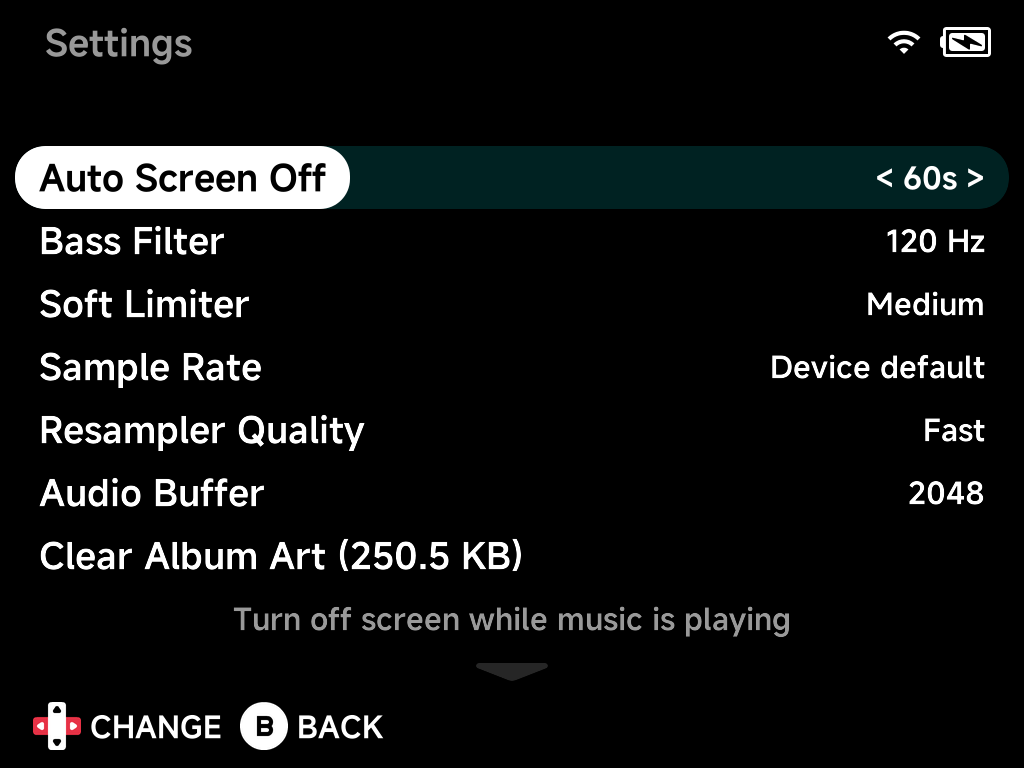
| Setting | What it does |
|---|---|
| Auto Screen Off | Idle time before the screen turns off during playback |
| Balance | The Game / Music mix, the same slider as in the OSD Music widget (see Background playback) |
| Bass Filter | High-pass filter to reduce speaker distortion |
| Soft Limiter | Limits volume peaks to prevent clipping |
| Sample Rate | Device default, or Follow source for bit-exact hi-res playback on USB DACs (no resampling). Applies on the next track |
| Resampler Quality | Higher quality costs more CPU |
| Audio Buffer | Larger buffers prevent dropouts |
| Clear Album Art / Clear Lyrics | Empty the on-SD caches |
Output routing is system-wide: speaker, Bluetooth or USB-C DAC, switched automatically as devices connect. See Settings → Audio.